People often say they are “bad at geography” when what they really mean is that their mental map is blurry.
The good news is that a better mental map is trainable. You do not need to memorize every capital, every border, or every airport code. You need a structure that helps the world make sense at a glance.
Start with scale, not trivia
The first thing a useful mental map gives you is scale.
You should be able to tell the difference between:
- neighboring-city scale
- same-country scale
- continental scale
- intercontinental scale
This matters more than remembering isolated facts. If your scale intuition is wrong, even correct place names will not help much in a distance game or route comparison.
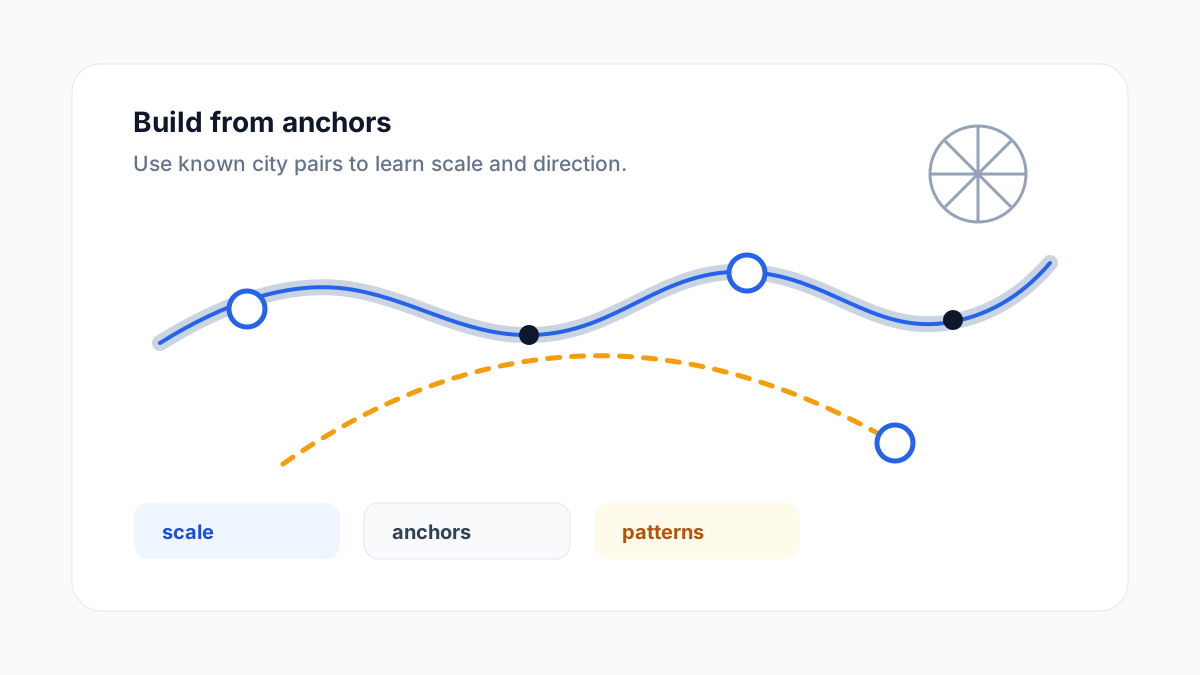
Learn anchor cities by region
Instead of trying to know every city equally well, build a small anchor set.
For example:
- North America: New York, Los Angeles, Chicago, Toronto, Mexico City
- Europe: London, Paris, Berlin, Rome, Madrid
- East Asia: Tokyo, Seoul, Shanghai, Hong Kong, Singapore
- Middle East and Africa: Dubai, Cairo, Johannesburg, Lagos, Nairobi
- South America and Oceania: São Paulo, Buenos Aires, Sydney, Melbourne
These anchors let you estimate new routes by comparison rather than from scratch.
Notice corridors, not just dots
A weak mental map sees cities as isolated points. A stronger one sees patterns:
- Atlantic corridor
- East Asian coastal corridor
- Western Europe cluster
- US East Coast corridor
- Gulf hub connections
Once you notice these patterns, distance clues become easier because you are not guessing across empty space. You are placing routes into familiar systems.
Use repeated comparisons
One of the best ways to sharpen your map is to compare unfamiliar routes against known ones.
Ask questions like:
- Is this shorter or longer than London to Paris?
- Is this closer to New York to Chicago or New York to Los Angeles?
- Is this clearly continental, or already long-haul?
This turns geography from memorization into reasoning.
Train with feedback, not just exposure
Looking at maps helps, but feedback helps more.
When you guess a distance and then check the actual answer, your brain gets calibration data. Over time, that repeated correction builds intuition much faster than passive reading.
That is why tools and quizzes matter. They give you a loop:
- estimate
- verify
- adjust
- remember the surprise
Pay attention to distortion
Flat maps are useful, but they can teach the wrong instincts.
Northern routes often look wider than they are. Great-circle paths bend. Oceans can appear smaller or larger depending on projection. A better mental map includes some skepticism about what a flat world image is telling you.
Keep a short list of “surprising truths”
Memorable geography facts improve your map because they challenge bad assumptions.
Examples:
- London and Paris are much closer than many people think
- New York to Los Angeles is enormous for a single-country route
- Northern routes often curve dramatically on flight maps
These surprises become anchor corrections in your mind.
Use tools to reinforce, not replace, intuition
The goal is not to stop using tools. The goal is to use them more intelligently.
With a better mental map, a distance calculator becomes a verification tool. A triangulation tool becomes a reasoning partner. A quiz becomes deliberate practice instead of blind guessing.
What improvement looks like
A stronger mental map does not mean instant precision on every route. It means:
- you classify scale faster
- you eliminate impossible answers sooner
- your first guess lands closer more often
- corrections make lasting sense
That is enough to make geography games easier, travel comparisons clearer, and global distance more intuitive in everyday use.