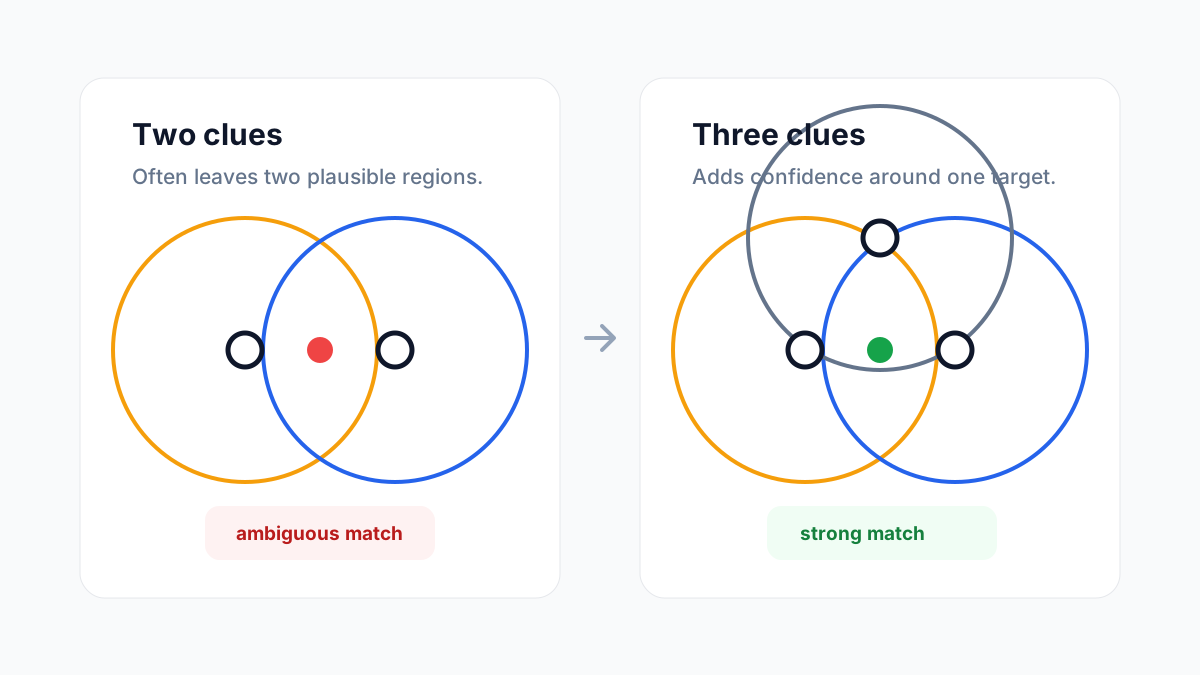
City triangulation sounds technical, but the basic idea is simple: each distance clue creates a circle around a known city, and the target city should lie somewhere on that circle.
The real question is not what triangulation means. The real question is how many clues you need before the answer becomes trustworthy.
What one clue gives you
One clue gives you a ring, not a solution.
If the target is 800 km from Rome, the answer could be in many different directions. Without a second reference point, you know distance but not location.
One clue is useful only for:
- excluding obviously wrong regions
- building a first shortlist
- checking whether your intuition is wildly off
What two clues give you
Two clues are where triangulation becomes interesting.
In ideal geometry, two circles intersect at up to two points. That means two distance clues can narrow the answer to:
- one clear area
- two candidate areas
- or no clean match if the clues are noisy
For geography games, two clues are often enough to get very close, especially when one of the candidates falls in the ocean or in an implausible region.
This is why two-clue solving feels powerful: the search space collapses fast.
Why two clues can still fail
Two clues are not always decisive because real data is messy.
Common problems:
- the game rounds distances
- the reference cities are too close together
- the target is near both circles but not exactly on either
- one clue creates two believable intersection regions
If your two circles point toward central Europe and western Asia at the same time, you still need judgment or more evidence.
What a third clue changes
A third clue is usually the difference between “probably” and “confidently.”
Instead of relying on where two circles cross, you now ask which candidate also fits a third distance. This does three things:
- removes mirror-image ambiguity
- absorbs rounding noise better
- makes ranking candidates much more reliable
In practice, three clues are much stronger than many players realize. Even if every number is slightly off, the correct city often remains the only place that is consistently close across all three references.
Best reference-city patterns
Not all clue sets are equally useful.
Good combinations usually include cities that are:
- far apart from each other
- spread across different directions
- globally recognizable
Weak combinations usually include cities that are:
- clustered in the same region
- nearly collinear with the target
- obscure enough to slow down your reasoning
For example, clues from London, Dubai, and Singapore usually give you better spatial coverage than clues from London, Paris, and Amsterdam.
When to stop at two clues
Two clues are often enough when:
- the intersection area is very tight
- one candidate lands in water or an unlikely location
- the nearest real city is much stronger than the runner-up
- you are playing quickly and only need a strong guess
This is common in game situations where speed matters more than exact certainty.
When to insist on three clues
You should wait for a third clue when:
- multiple cities sit near the same intersection area
- both candidate regions are plausible
- the distances are long enough that small errors cover huge areas
- you want to publish or share the result confidently
If the route spans multiple continents, the extra clue is especially valuable.
How CityDistance handles the problem
The triangulation tool is built around the practical version of this workflow:
- take reference cities
- draw distance circles
- find likely intersections
- rank nearby cities by fit
That last step matters. Real-world triangulation is rarely a perfect compass-and-ruler problem. It is a ranking problem with geographic noise.
A practical solving workflow
If you are playing manually, this sequence works well:
- Enter the first two clues and inspect the candidate area.
- Note the top 2 to 5 plausible cities.
- Add the third clue only after you understand the ambiguity.
- Compare total error across the remaining candidates.
That method is faster than waiting passively for the tool to decide everything.
The takeaway
Two clues are often enough to narrow. Three clues are what make the answer robust.
If your goal is quick intuition, learn to work confidently with two clues. If your goal is reliability, especially for harder rounds and long-distance puzzles, the third clue is where triangulation stops being a guess and starts becoming evidence.