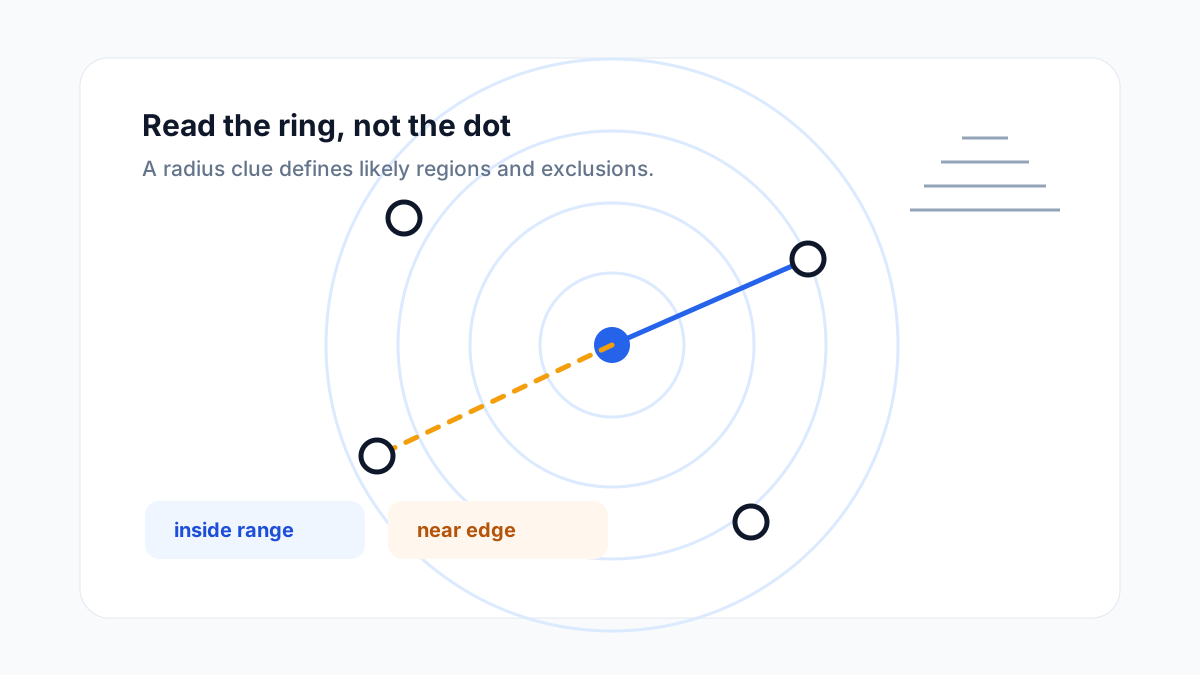
Radius clues look simple: a city and a distance. But strong players do more than draw a circle in their head.
They use the clue to eliminate entire regions, judge scale quickly, and decide what kind of answer is even possible.
A radius clue is a boundary, not a destination
If you learn that the target is within 500 km of a known city, that does not identify one place. It defines a search area.
That search area is useful because it immediately answers three questions:
- what nearby cities are plausible
- which directions still fit
- which cities are definitely too far away
Most bad guesses happen because players focus only on what is inside the circle and ignore how much has been excluded outside it.
Learn the feel of common radius sizes
Different radius values imply different game states.
100 kmusually means local or metro-adjacent300 to 500 kmoften means regional1,000 kmcan cover multiple major cities in dense parts of Europe or East Asia2,000 kmis broad enough to include multiple countries or a large part of a continent
If you misread the scale, everything after that becomes noisy.
Direction still matters even when the clue does not mention it
A radius clue alone is symmetrical, but real geography is not.
Water, coastlines, and city distribution create uneven candidate zones. A 500 km radius around London includes very different possibilities to the west than to the east. The same is true around New York, Tokyo, or Johannesburg.
That means you should ask:
- does most of the circle fall over land or water?
- which major cities actually exist in that band?
- is the likely answer in a dense or sparse region?
Radius clues become stronger when combined with familiarity
The best radius readers do not memorize every city. They memorize the structure of a few regions.
For example, if you know that a 500 km radius around Shanghai quickly reaches Suzhou, Hangzhou, Nanjing, and Ningbo, you can reason much faster than someone who treats East China as blank space.
You do not need a huge memory bank. You need a few reliable anchors in each major region.
Use the radius to eliminate, not just include
Suppose a clue says the answer is within 300 km of Paris.
That does not just make Brussels plausible. It also makes Berlin implausible, Madrid impossible, and Rome absurd. Good solving is often about confident elimination before exact identification.
The same logic helps when you combine radius and distance clues. One clue builds the possibility set. Another clue cuts it down.
Why dedicated radius tools help
Humans are bad at manually visualizing circular geography on a globe, especially when the map is flat and the region crosses coastlines.
That is where a tool becomes more than a convenience. A good radius search lets you:
- visualize the boundary directly
- inspect which cities fall inside it
- compare multiple radius sizes quickly
- turn vague intuition into a ranked list of actual candidates
A useful workflow for games
When you get a radius-style clue:
- classify the scale
- note whether the circle mostly covers land, sea, or both
- list the most likely major-city candidates
- wait for a second clue before overcommitting
That process is faster and more accurate than trying to imagine an exact circle from memory.
The main mistake to avoid
Do not treat a radius clue as if it were a precise pointer.
It is a filter, and filters become valuable when you use them to shrink the search space methodically. Once you do that consistently, radius clues stop feeling vague and start feeling like one of the cleanest clue types in geography games.